
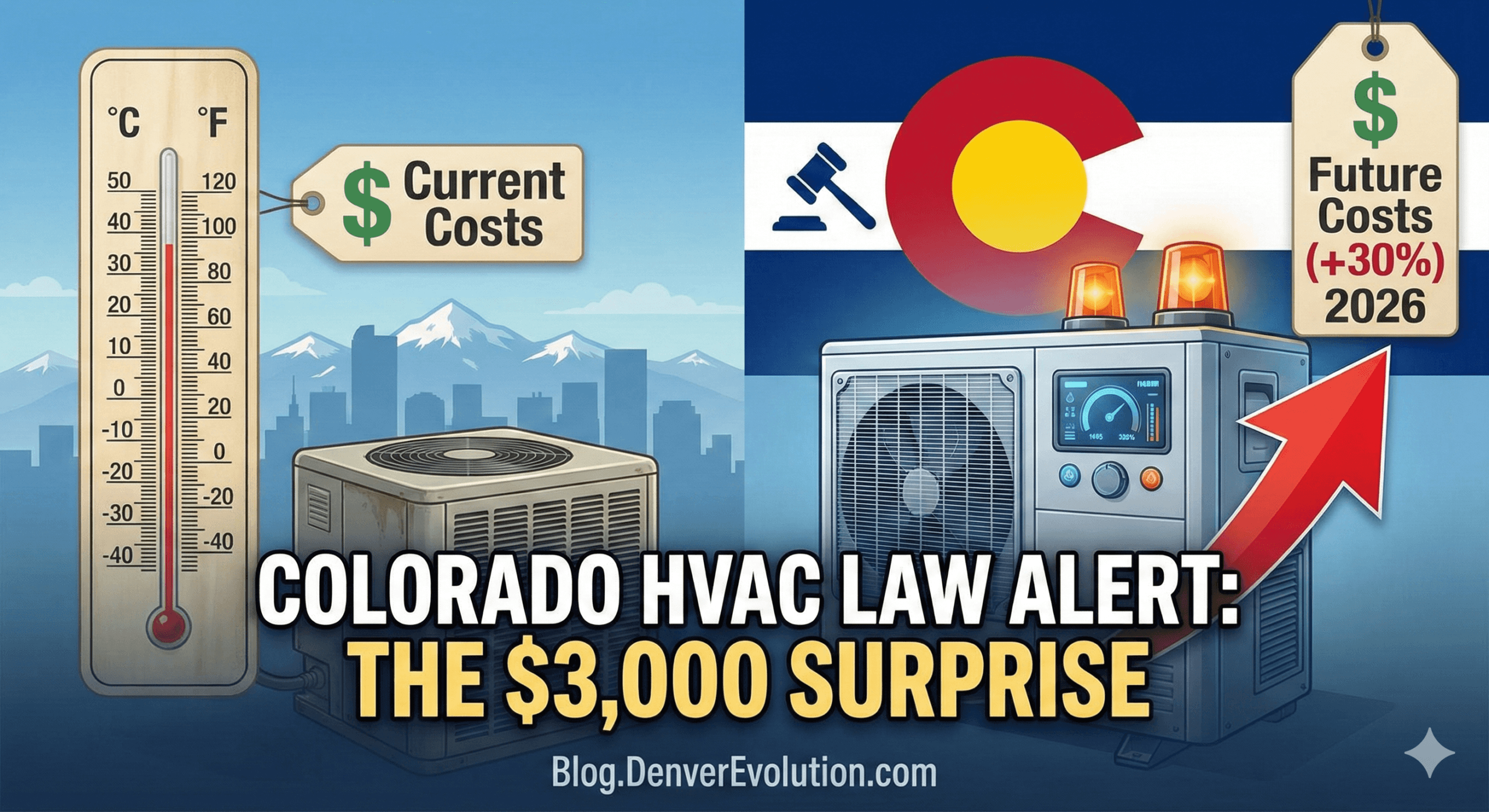
New Colorado HVAC Laws: Why Costs Are Increasing 30% in 2026

If you own a home in the Denver Metro area or are planning to buy one soon, you need to pay attention to a major shift in Colorado HVAC laws.
We aren’t just talking about inflation. A “double whammy” of federal and state regulations is about to fundamentally change the heating and cooling equipment we can install in Colorado. The bottom line? New systems are expected to be roughly 30% to 40% more expensive starting in 2025 and 2026.
Here is everything you need to know about the changes, the costs, and how to protect your wallet.
The “Double Whammy” of Legal Changes
Two separate mandates are colliding to drive up prices. It is important to understand that these are legal requirements, not just manufacturer price hikes.
The Federal Refrigerant Shift (The “AIM Act”)
Effective: Phasing in now; strict enforcement Jan 1, 2026.
The EPA is phasing out the current standard refrigerant (R-410A) because of its high Global Warming Potential (GWP). All new air conditioners and heat pumps must switch to new “A2L” refrigerants (like R-454B).
Colorado’s Ultra Low NOx Law (HB23-1161)
Effective: Jan 1, 2026.
Specific to Colorado, this law bans the sale of standard gas furnaces and water heaters to reduce nitrogen oxide emissions.
Cost Breakdown: Now vs. The Future
As a Real Estate Professional, I crunch numbers daily. Here is what the average HVAC replacement costs look like in Denver today versus what we expect once these mandates fully take effect.
Equipment Type | Avg. Cost (Current) | Est. Cost (Post-2026) | The “Wait” Penalty |
|---|---|---|---|
Gas Furnace | $4,500 – $6,500 | $7,000 – $12,000 | $3,500+ |
Central A/C | $5,000 – $8,000 | $6,500 – $10,500 | $1,500+ |
Full System | $10,000 – $14,000 | $14,000 – $20,000+ | $4,000+ |
> Note: These estimates are for the Denver Metro area and include installation. Prices vary by home size and efficiency rating.
What This Means for You
Depending on your position in the market, your strategy should change.
For Homeowners
If your system is 12-15 years old, do not wait for it to die. Replacing it now (before the existing inventory of standard units is depleted) could save you $3,000 to $5,000. Plus, current systems are simpler to repair than the incoming high-tech units.
For Buyers
You must look closely at the age of the HVAC during inspection.
For Sellers
A brand-new, compliant HVAC system is about to become a massive selling point. Marketing your home as “Future-Proofed” with a new system can alleviate a huge fear for buyers and justify a higher list price.
For Investors
Your CapEx (Capital Expenditure) budget needs an update.
Your Next Step
Do not get caught off guard by a $15,000 bill in the middle of winter. If you are unsure about the age or condition of your system:
Would you like me to recommend my trusted HVAC vendor for a “Pre-Compliance Audit” of your home’s mechanicals?
Frequently Asked Questions
Will my old AC become illegal?
No. You can keep running your current system. However, repairing it will get expensive as the old refrigerant (R-410A) becomes scarce and costly to buy.
Can I just repair my way out of this?
For a while, yes. But once the compressor goes on an old A/C, or the heat exchanger cracks on an old furnace, you will be forced to buy the new, more expensive compliant units.
Are heat pumps affected?
Yes, heat pumps must also switch to the new refrigerant. However, Colorado and federal rebates are aggressively targeting heat pumps, which might make them the most improved financial option despite the hardware cost increase.