
Denver Metro Housing Update: The February 2026 Spring Transition

Key Details
The February Crossroads: A “Start-and-Stall” Recovery
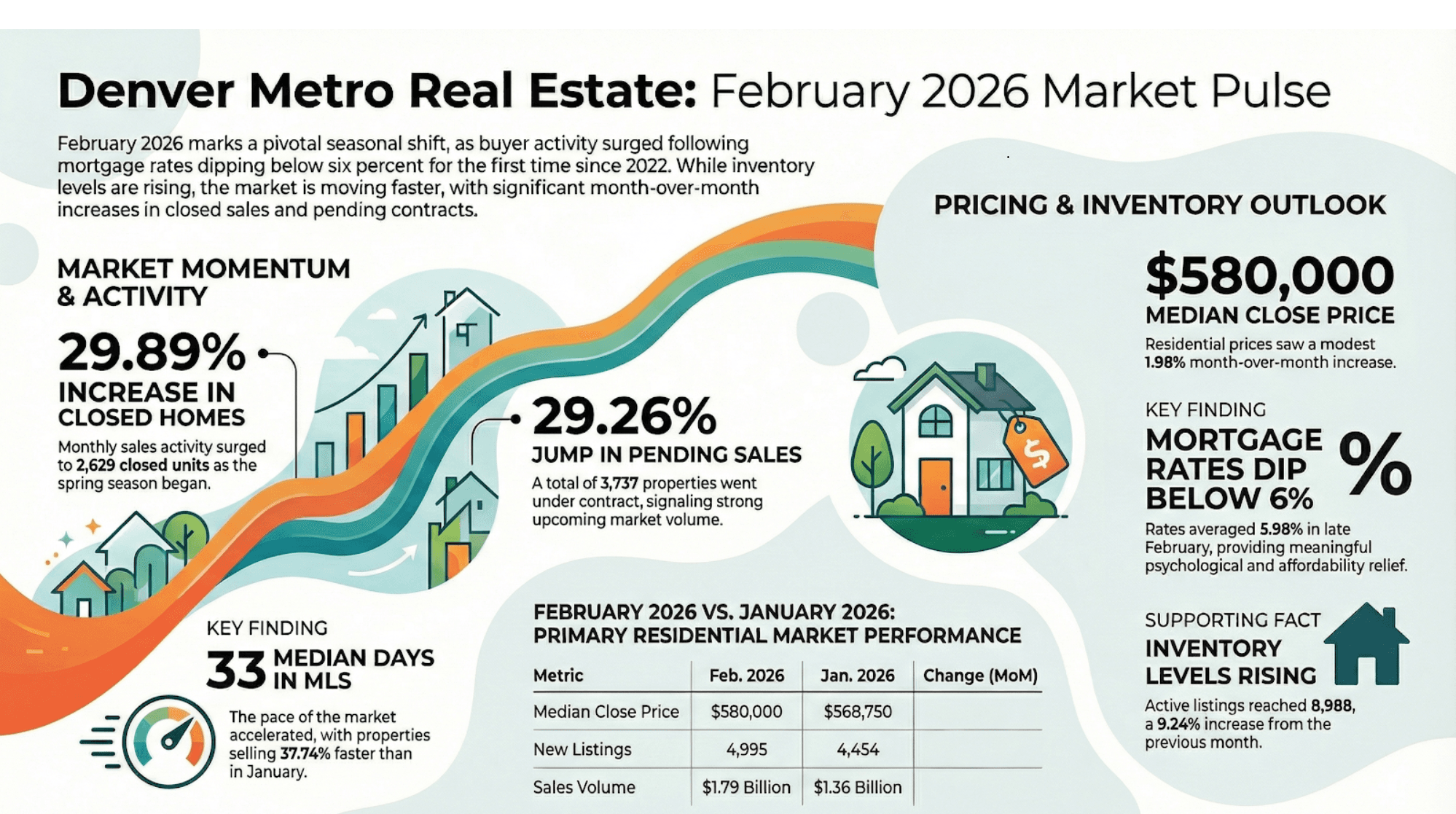
The Denver Metro Housing Update for February 2026 reveals a market at a critical juncture. As we transition from the winter lull, unseasonably warm weather has acted as a catalyst, pulling buyers off the sidelines earlier than anticipated. This shift is not merely seasonal; it is a structural recalibration as the market adjusts to more predictable economic conditions and stabilizing interest rates.
While closed sales saw a robust 29.89% month-over-month increase, the broader year-over-year data suggests a more cautious framework. The “Great Housing Reset” predicted for 2026 is taking shape, characterized by a slow but steady normalization where income growth is finally beginning to outpace home-price appreciation.
February 2026 Statistical Landscape
| Metric | February 2026 | Jan 2026 (MoM Change) | Feb 2025 (YoY Change) |
| Median Close Price | $580,000 | +1.98% | -3.33% |
| Active Listings | 8,988 | +9.24% | +5.07% |
| New Listings | 4,995 | +12.15% | +3.59% |
| Pending Sales | 3,737 | +29.26% | +15.27% |
| Median Days in MLS | 33 | -37.74% | +13.79% |
Data reflects combined residential trends for the 11-county Denver Metro area.
Supply Dynamics and the “HOA Factor”
Inventory remains the primary indicator of market equilibrium. The 12.15% spike in new listings this February has provided buyers with a “fresh batch” of options, granting them critical leverage that was absent during the low-inventory years of 2021-2024.
However, a sharp bifurcation has emerged between property types. Detached homes remain in high demand, while the attached segment (condos and townhomes) faces increased scrutiny. Rising HOA fees and insurance premiums—driven largely by regional hail damage risks—have made buyers more selective. To succeed in this Denver Metro Housing Update, sellers of attached units must go beyond basic listings, using professional staging and transparent value-add communication to overcome these monthly cost hurdles.
Strategic Opportunities for Buyers and Sellers
The “COVID frenzy” has been replaced by a market of selective, highly informed purchasers. Today’s buyers are prioritizing “turnkey” properties and are willing to move with high velocity—often closing in under 30 days—when a property meets stringent criteria for location and condition.
To combat recent interest rate volatility, savvy participants are increasingly utilizing rate buydowns and Adjustable-Rate Mortgages (ARMs). These tools are essential for maintaining affordability, especially as the median rental price for single-family homes in Denver has climbed to $2,750, reinforcing the long-term case for ownership.
Ready to navigate the new Denver market?
Whether you are looking to leverage your buyer power or need a data-driven strategy to sell your home in a balanced market, we are here to help.