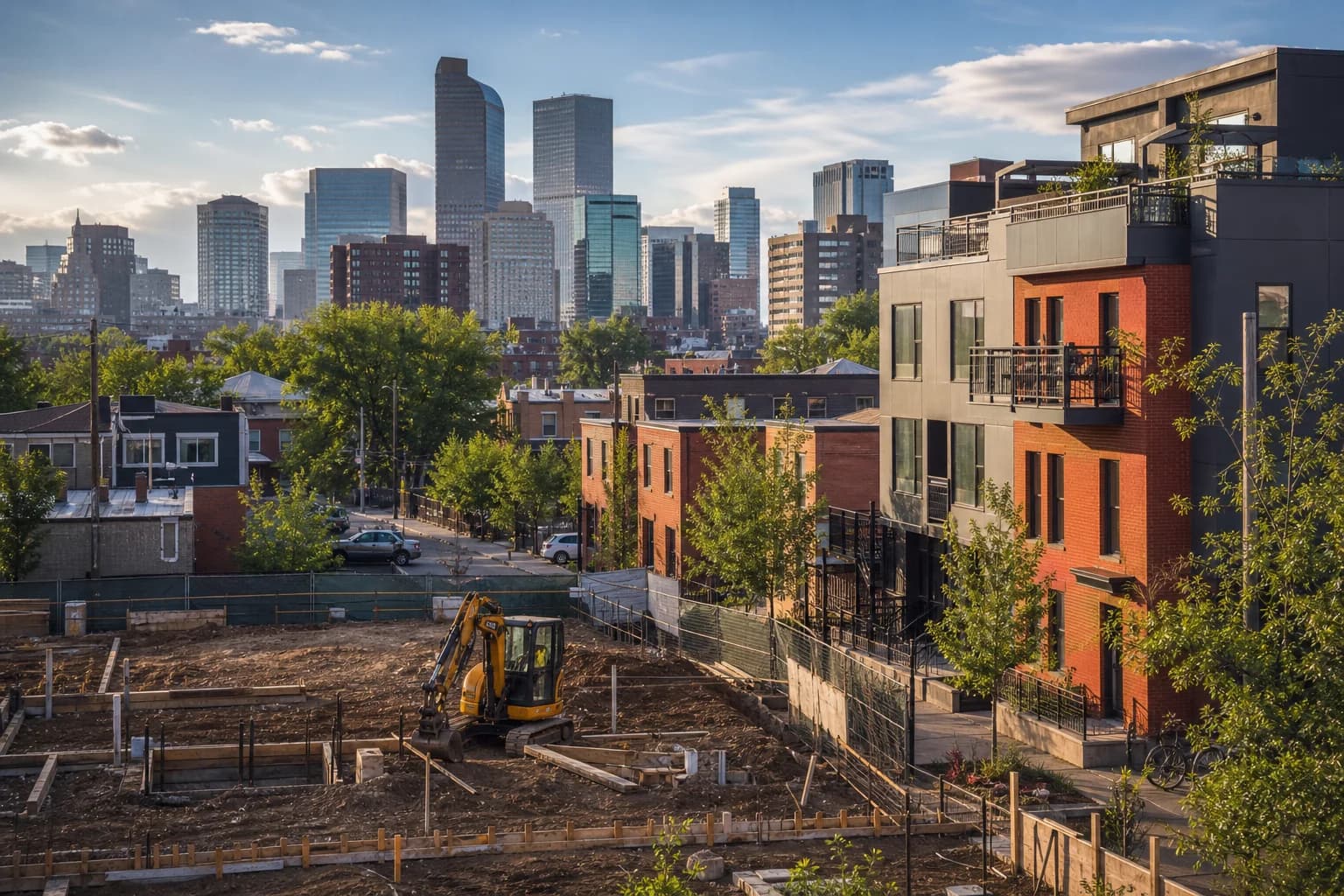

The City admitted what the bond market has been screaming for two years: at these rates, you can't build.
On May 4, 2026, Denver City Council unanimously extended the expiration on every Site Development Plan approved on or before December 31, 2025 - by 36 months. Three years. The reason cited in the record was financing. High construction costs. Higher rates. Soft rents. Approved projects sitting in drawers.
If you're a homeowner, an investor, or someone wondering why the new-construction pipeline feels slower than it should, this one's worth understanding. Because what looks like a procedural footnote is actually a confession - and it tells you a lot about where Denver's housing supply is going for the next two to three years.
What's an SDP, in plain English
An SDP - Site Development Plan - is the City of Denver's site-specific approval document that turns a zoned-and-feasible parcel into a project that's actually allowed to break ground. Plans, civil engineering, drainage, utilities, fire access, parking, the works. It's the second-to-last gate before a building permit.
SDPs expire. Historically, you had a finite window after approval to pull permits and start construction, or the SDP went stale and you started over.
That's the gate Denver just held open for 36 more months.
Who this affects
Anyone holding an approved-but-unbuilt SDP from any time in 2024, 2025, or earlier just got a free three-year hold on their position. That includes:
- Mid-rise apartment developers who entitled at sub-5% construction-loan rates and are now staring at 8%+ on the same project pro forma.
- Townhome and small-builder shops that were ready to break ground in 2023 and watched the math turn upside down.
- Affordable-housing partnerships layered with LIHTC, City subsidies, or state credits that need a long fuse to assemble capital.
- Mixed-use projects whose retail leasing assumptions died with the office vacancy story (Denver downtown sits at roughly 40% office vacancy as of this report).
What they all have in common: the project pencils at lower rates or higher rents, and the City is buying them time to wait.
Why the City did it
Officially: "financing crisis." Unofficially: the alternative was a wave of expired SDPs and a stalled-out 2026-2028 supply pipeline at the exact moment Denver is trying to deliver 2,500 affordable units and permit another 5,000 in 2026 alone.
If those SDPs expire, every one of them goes back through Community Planning and Development for re-approval. Months at a minimum. In some cases, a whole new design cycle. Inventory the City was counting on disappears from the ledger.
So the City extended. Not because the math suddenly worked - because letting it not work in public would have been worse.
It's the municipal equivalent of "we'll roll it next quarter." Just bigger.
What this means for the next 24-36 months
This is where it gets interesting. A few things follow from a 36-month extension.
One: short-term supply is going to look worse than reality. A lot of approved projects that might have broken ground in 2026 will instead wait. Builders are not going to start a project at today's construction loan rates if they have a legal option to wait for cheaper money. Expect the Q3 and Q4 2026 starts numbers to underwhelm relative to entitlements on file.
Two: the pipeline didn't shrink. It just got time-shifted. If rates compress meaningfully in the next 18-24 months, a lot of these SDPs become live projects fast. Denver's supply story over 2027-2028 is mechanically tied to this extension. Watch the construction-loan rate curve more carefully than you watch the residential 30-year.
Three: the smart money is positioning right now. Former Mayor Hancock just bought the 7,600-square-foot Triangle Building on Washington in Five Points for around $1.4 million. His quoted reason: "Real estate is still one of the more sure investments you can make." That's not a coincidence with this SDP move. That's people with capital and a long view buying when the news cycle is still about hard money and stalled cranes.
Four: existing inventory just got more important. If new-construction supply lags through 2026 and into early 2027, the resale market carries more weight - and pricing power - than the headline numbers would suggest. Denver's three-year flat band on median price ($602K → $604K → $605K) is partly because of inventory still being relatively constrained against demand. An SDP-led supply lag extends that.
A worked example
Take a hypothetical 80-unit Denver mid-rise. Let's say it was approved with an SDP in early 2023. Construction loan assumptions back then: ~5% on a senior debt facility. Hard costs: $310 a square foot. Rents underwrote at $2.40 per square foot.
Today the same project pencils very differently:
- Construction loan: closer to 8.5% on senior debt
- Hard costs: $370+ per square foot (post-2022 cost ratchet, no give-back)
- Rents: closer to $2.10 per square foot, soft, and you're competing with $180/month concessions on every comp building
Without the SDP extension, the developer's options were ugly:
- Build now at a money-losing pro forma to preserve the entitlement.
- Let the SDP expire and re-enter the approval process from scratch.
- Sell the entitled site at a loss to whoever has cheaper capital.
With the extension, option four exists: sit. Let the rate environment soften. Watch the cost ratchet roll back as more service-trade capacity comes back online. Re-engage in 2027 or 2028 when the math actually works.
The City didn't change the project. It changed the clock.
Why this matters for buyers and investors
Three takeaways:
If you're a buyer: new construction in Denver isn't going to flood the market in the next 18-24 months. The story I keep hearing from sellers is "we'll wait for more inventory to push prices down." Inventory is rising in resale, but not enough to dilute well-priced product, and new construction is on hold. If you're trying to time a 5-10% pullback in resale prices on the back of a Denver new-construction wave, you're going to wait a long time.
If you're an investor: the pricing dislocation between resale-priced product and replacement cost is wider than it's been in years. Buying existing for less than what you can build it for is a classic Denver setup, and it's back. Worth running underwriting on small-multifamily and townhome opportunities specifically.
If you're a developer: congrats, the City just gave you a hall pass. Use the next 18 months to refine the pro forma, re-bid hard costs, and pre-position capital. The next rate window is going to be competitive when it opens.
The bigger picture
The SDP extension is one of those institutional moves that doesn't make the front page but tells you everything about where the cycle actually is. The City of Denver does not extend approvals lightly - and 36 months is a long extension, not a procedural three-month patch.
Translation: even Denver's planning department thinks we're in this rate environment for a while.
Plan accordingly. Or stop planning around it and just buy the right resale property at the right price - which, conveniently, is what I do for a living.
If you want to talk through what this means for a specific property, neighborhood, or investment thesis, give me a call. Twenty minutes and you'll have a clearer read on Denver supply than 95% of the people quoting this market on TV.
If you own too much real estate, or not enough, call me, I can fix that for you!
- Chris