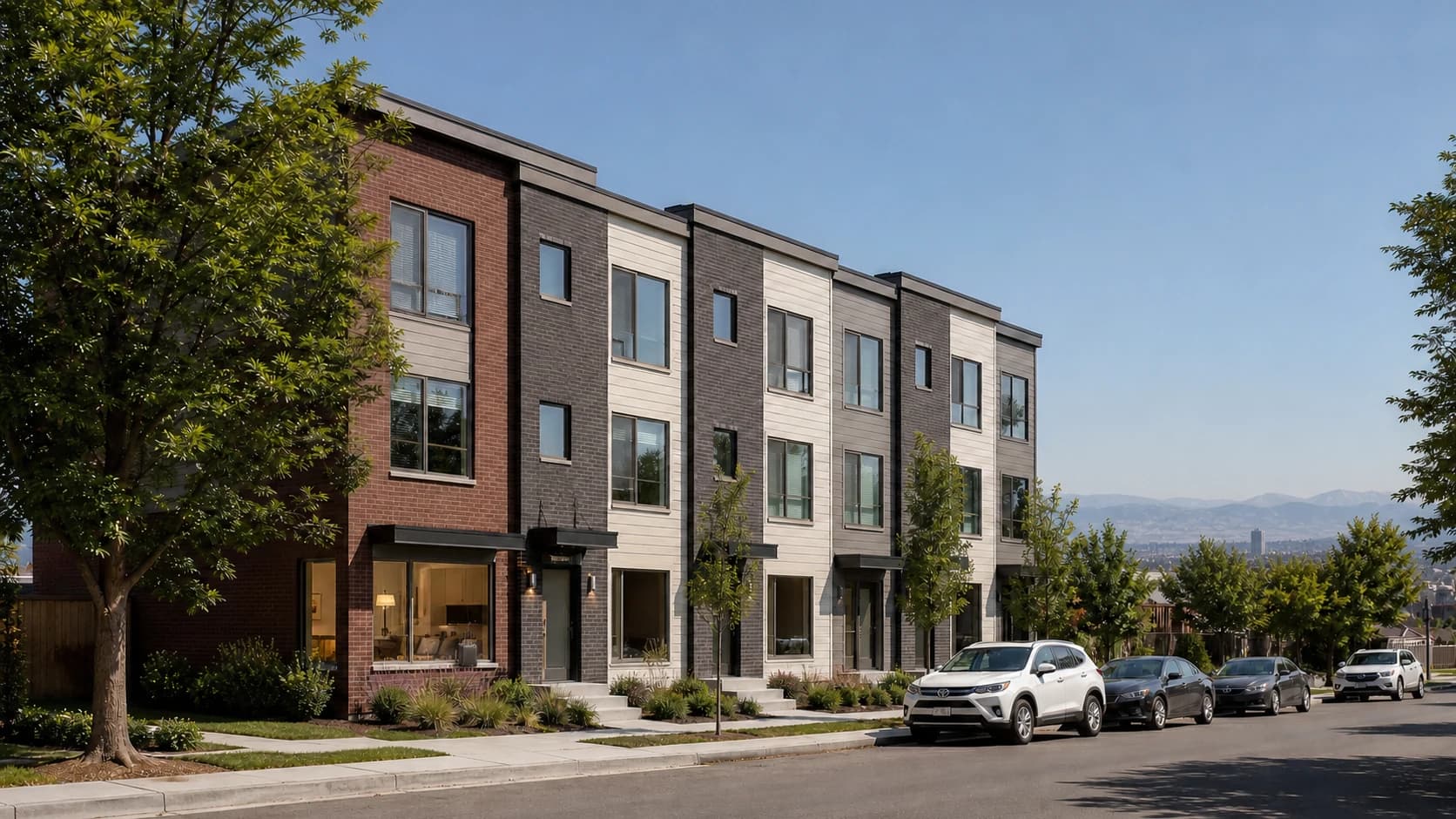

Some of the most interesting real estate conversations I’ve had lately are about units that did not sell.
A few developers at MODUS have been working through a difficult part of today’s market: well-built townhomes and small condo projects - built on underwriting from 3-4 years ago - just aren’t selling without taking a massive loss. Rather than cut the price until it hurts, many are furnishing those units and offering them as “mid-term” rentals (3-12 month leases) and finding that they can cash flow with apparently much higher demand than they’re finding in the long-term rental market.
For them, this is a bridge strategy, but I think it points to a timely opportunity for savvy investors.
Why I’m looking at small multifamily again
Prices have adjusted. Yardi Matrix reported that the average price per unit across Denver’s broader multifamily market fell 11.4% through April. That doesn’t mean every duplex, triplex, fourplex, or small building is suddenly a bargain. It does mean the market has reset enough that some properties deserve a fresh look before rents start to recover.
The challenge is income. Traditional rents have softened while borrowing costs remain high. Large apartment operators are still using free months, waived fees, and other concessions to fill recently completed buildings. That competition has pulled down effective rents and made an ordinary long-term rental near-impossible to pencil without drastic price cuts. The kind of price cuts that - understandably - make most sellers decide to hold-out for a more favorable market.
This gap hasn’t just sidelined sellers. Anyone who’s dipped their toes into buying a rental property over the last 3-or-so years has quickly pulled back once they see the math. When prices are 15%-20% over what you’d need just to break-even on cash flow, the chances of finding a deal that works are slim to none.
That’s where a furnished, mid-term rental strategy can change the equation. At the very least you can turn what most sellers would consider a “low-ball” offer into more of a slow-pitch…something that has a real shot.
How mid-term rentals work
The typical tenants in the mid-term market are your traveling nurses, consultants, or anyone on a short(ish) term assignment backed by a stipend from their employer. Other times, you’re renting to people just moving to Colorado and aren’t sure where they want to set their roots, or you have someone who’s waiting for a house to be built. Low drama, very transactional, and you’re almost never left wondering if rent will be late or short. Often, they even pay the entire lease term up-front.
It’s not automatic profit. Your underwriting should include vacancy, utilities, internet, furnishings, cleaning, management (don’t try to self-manage unless this is your full-time job), insurance, turnover, reserves, and any HOA or other restrictions. But when those costs are measured honestly, the additional income can be enough to bridge the gap between a property that loses money as a conventional rental and one that can carry itself.
This appears especially promising for efficient one- and two-bedroom units. They’re easier to furnish, less expensive to operate, and often a practical fit for someone who needs a real home for several months without buying furniture or signing a long lease.
The timing may be better than it looks
Today’s rent pressure is real, but the construction cycle is already turning.
In the second quarter, more than 8,300 metro-area apartments were absorbed while roughly 3,300 new units were delivered. At the same time, the future development pipeline has been shrinking. Industry forecasts expect new completions to decelerate quickly in 2027, with a long runway before they ramp up again.
That doesn’t guarantee a rent spike, but it does suggest that today’s deep apartment concessions are unlikely to be a feature of the market for much longer.
This provides a window of opportunity to buy at a low basis now, create enough income to avoid carrying negative cash flow, and be very well positioned before supply pressure eases.
A much stronger investment thesis than simply hoping interest rates fall.
A few ways to approach it
-
Exchange an aging property. If an older rental has accumulated deferred maintenance, weak cash flow, or too many management headaches, a 1031 exchange may allow an owner to move equity into a cleaner property with a better mid-term rental profile. I just so happen to know some operators with some stabilized units that they might part with.
-
Use retirement funds carefully. Some investors use self-directed retirement accounts to hold real estate. The rules against personal use and self-dealing are strict, so this requires an experienced custodian and tax or legal guidance - but I have some wonderful connections for anyone interested in exploring this option.
-
Evaluate cost segregation. A well-supported cost-segregation study may identify parts of the property that can be depreciated much faster than the building itself. Under current federal law, shorter-lived components may be eligible for 100% first-year bonus depreciation. That can materially improve the investment’s early after-tax return, although it doesn’t create operating cash flow, proper tax strategy often becomes the investment. This is something to model with a CPA, not assume in the purchase price.
-
Buy only what works on conservative assumptions. I would underwrite the property with realistic occupancy and every furnished-rental expense included. Future rent growth should be upside, not the thing rescuing the deal.
-
Target the right unit, not just the lowest price. Location, layout, parking, building rules, furniture cost, and the likely mid-term tenant matter more than a flashy discount.
What still has to pencil
The rent premium is only useful after accounting for everything required to earn it. I would want to see the mid-term income tested against utilities, internet, furniture replacement, cleaning, vacancy between leases, management, insurance, HOA restrictions, repairs, and reserves.
I would also run the property as a conventional long-term rental. That downside case matters. If the mid-term strategy underperforms, the property should still have a defensible use rather than becoming a furnished liability.
The best candidates are not simply the units with the largest price reductions. They are the units where the layout, location, parking, building rules, and expected tenant fit create a durable advantage—and where the acquisition basis leaves room for the additional operating costs.
This is still a regulated rental
A three- to twelve-month lease is not the same thing as running a nightly rental, but “mid-term” is not a magic regulatory category.
Denver treats property offered as a residence for 30 days or more at a time as residential rental property and requires the applicable residential-rental license. Other municipalities, HOAs, lenders, and insurers may draw their own lines. The exact property and operating model should be checked before making an offer.
The investment window
I think there is a real window here: small multifamily pricing has become more attractive, conventional rent pressure has created motivated sellers, and a mid-term strategy may provide the income needed to hold through the current cycle without accepting negative cash flow.
If you have an older property you are tired of maintaining - or cash, equity, or retirement funds that you would like to evaluate - I would be glad to help you compare the options and underwrite the numbers honestly.
Call or text me at 303.815.6243.
This article is for general information, not individual investment, legal, or tax advice.
Sources
- Yardi Matrix — Denver Multifamily Market Report, June 2026
- Axios Denver — Why Denver’s rent relief may not last long, July 28, 2026
- City and County of Denver — Residential rental property licensing
- IRS — Like-kind exchanges: real estate tax tips
- IRS — Retirement topics: prohibited transactions
- IRS — Additional first-year depreciation guidance