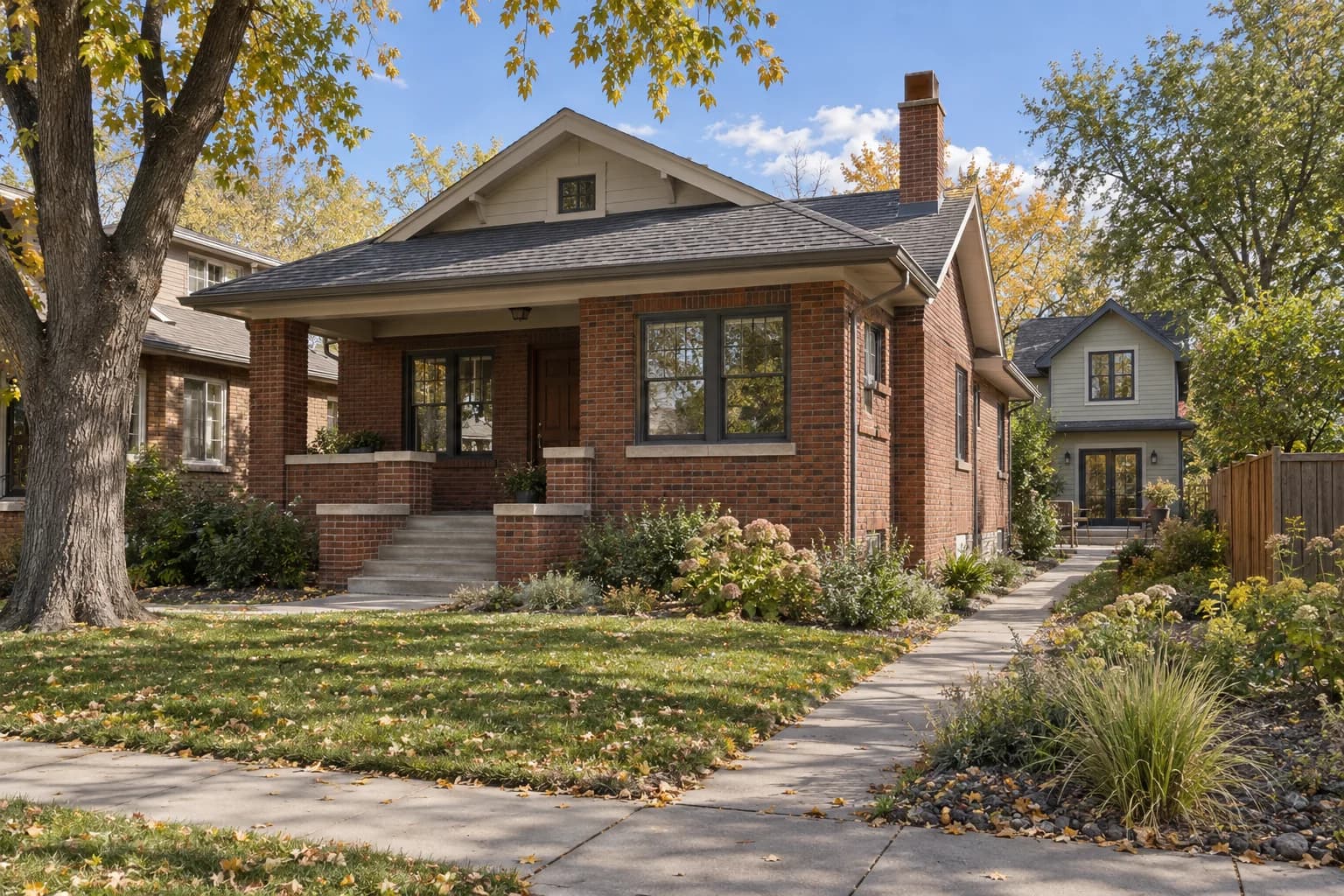

Here’s a Denver story you’ve seen a hundred times.
An old bungalow sells. A fence goes up. A few months later the bungalow is gone, and a much bigger, much more expensive house is standing where it used to be. The block has the same number of homes it had before. One of them just costs a lot more.
Between 2010 and April 2025, Denver redeveloped about 237 single-unit homes a year, and 65% of them were replaced by another single-unit home. That’s a lot of construction that added no new households.
I’ve written before about what happens when a scrape turns into a neighborhood fight. The argument usually collapses into one side yelling “character” and the other yelling “density,” and nobody gets a place to live out of it.
So this month I want to look at three projects around the metro that are trying something different. None of them start from a blank slate. One keeps the house. One keeps the building. One just builds less house, on purpose.
They’re at very different stages, and none of them solves housing by itself. What they have in common is that each one adds homes without tearing everything down first.
Keep the house, add a home
Denver’s Unlocking Housing Choices project is the city’s big “missing middle” zoning effort, and the piece I care most about is what the city calls a retention bonus.
The idea is simple: keep the existing house, and you’re allowed to add more homes on the lot. A second home behind the bungalow. A unit carved out of the existing structure. Instead of the scrape being the most profitable move by default, keeping the house becomes part of the math.
The city’s August feasibility study found that keeping the house lets its value carry into the new project, instead of paying to tear it down and replace it. In plain terms, the house you already have is worth money, and knocking it down throws that away.
There are limits. City staff laid out the current version for City Council and the Planning Board on September 28. The extra homes would only be allowed on lots within a quarter mile of a rail station or one of the city’s Transit Priority Streets, which covers about 54% of Denver’s single- and two-unit neighborhoods. The map is still a draft. A lot could have up to four homes in the city’s urban and urban-edge neighborhoods, and two in the suburban ones. To qualify by keeping the house, the house has to be at least five years old and stay standing for five years after. No affordable unit is required for that. A second bonus allows the same number of homes without keeping the house, as long as one of them is affordable to a household at 70% of area median income for a rental, or 100% for a home that’s sold.
What the proposal doesn’t do is cap how big a new house can be. The city studied size limits and chose to leave them out of this first phase, to see what actually gets built before setting one. Rules for height and how a building steps back from its neighbors would still change citywide, whether or not a lot qualifies for extra homes.
Council’s reaction was mixed, and since it was a work session, nobody voted. Councilmember Amanda Sawyer said she can’t support it as written, because without a size limit it doesn’t stop the thing that started this whole conversation: a modest house scraped for a mansion built setback to setback. Councilmember Chris Hines called leaving out size limits a green light for monster homes. Others, like Councilmember Darrell Watson, said they’d back a smaller first step if that’s what it takes to get a majority. Planning Board chair Caitlin Quander said holding off on size limits until the city sees what gets built was the right call.
Nobody knows yet how many homes this would actually produce. Going by staff’s rough math at the meeting, something like 40 to 340 single-unit lots a year could turn into missing-middle homes, depending on the market. Zoning only makes it legal. Whether anyone builds depends on the market.
Then there are the practical questions that decide whether a project actually happens:
- Can the new home be sold on its own, or only rented? A backyard home is far more useful to a buyer if they can actually own it, and zoning alone doesn’t settle that. Access, utilities, maintenance and how the property is legally divided all need workable answers.
- Is the existing house sitting in the right spot on the lot?
- What will a lender actually finance?
- What does the new home need to sell or rent for to make the numbers work?
An owner who bought twenty years ago is looking at very different math than a builder buying the same lot at today’s price. And before any of that, check whether your lot is close enough to transit to qualify at all.
One big caution: none of this is law yet. The city plans to draft the actual code changes this winter, hold a Planning Board hearing, and bring it to City Council for a vote in late winter or spring 2027. If someone tells you fourplexes are legal everywhere now, they’re wrong. Under this version, they wouldn’t be legal everywhere even after it passes. The city has public meetings on the calendar for November 4 through 19.
Keep the building: the old VA hospital
At 1055 Clermont Street, a developer is turning a 10-story hospital that sat empty for years into apartments.
Full disclosure before I go any further: Ben Gearhart and Chuck Moore, who own my brokerage, MODUS, are also principals of GM Development, the developer here.
GM bought the 8.3-acre campus at auction in 2022 for roughly $41 million. The plan converts the hospital building into 493 apartments with some retail. This spring, Walker & Dunlop arranged a roughly $130 million HUD construction loan for the conversion, which the firm calls the largest HUD loan in its history, and historic tax credits are part of the funding as well. About 8% of the apartments, roughly 40 of them, will be reserved for households earning 60% of area median income or less.
Walker & Dunlop’s account is worth reading because it shows how much work sits between a good idea and a finished apartment. It describes nearly two years of zoning, entitlement and redevelopment approvals before the financing came together. Every one of those months is a month of carrying a building that produces zero rent. HUD financing at this scale is rare, and without the tax credits the numbers probably don’t work.
Hospitals are not apartments. The hallways, floor depths, mechanical systems, elevators, windows and exits were all designed around patients, not households. A ground-up developer draws whatever they want. A reuse developer works around whatever is already standing. That’s the trade: you keep a landmark building and skip the wrecking ball, but you inherit every quirk it came with.
To be clear, this isn’t 493 finished homes yet. It’s a mostly market-rate rental project, and it won’t help a first-time buyer who wants to own. What it does is put hundreds of households in an established neighborhood, in a building that already exists.
The city is trying to make this kind of project easier, at least downtown. Denver runs an Adaptive Reuse Pilot Program that gives conversion projects a coordinator to help them through review and permitting, and the Downtown Denver Development Authority has been putting gap financing into office-to-residential conversions. That helps. But walking a few projects through a hard process isn’t the same as making the process easier, which would help every project after them.
Build less house, on purpose
The third example doesn’t involve an old building at all. It’s just a smaller house.
Up in Broomfield, at Baseline, Boulder Creek is selling what it calls wee-Cottages: detached single-family homes starting around 1,430 square feet, with three or four bedrooms, two- or three-story layouts, attached two-car garages off the alley, and yards the builder itself describes as modest (“perfect for a small garden or a cozy seating area”). Advertised from $512,000.
For context, the same builder’s larger Limited Edition homes at Baseline start at $949,000. Same neighborhood, same parks and trails, and a gap of about $437,000 in starting price. That’s what you save by buying less house.
The name sounds like a tiny-house thing. It isn’t. These are real homes with bedrooms and garages. What’s different is how much house and how much dirt you’re signing up for. For a buyer who wants a detached home (no shared walls) but doesn’t want to mow a quarter acre or pay for rooms they’ll never use, that’s a legitimate option.
The trade-offs:
- Stairs. Some of the plans are three stories. That’s a lot of climbing with groceries, a toddler or bad knees, and it’s a real problem if you want to stay in the house as you get older.
- The yard is small. Great for a patio, not so great for a big garden or a big dog.
- Shared parks and trails are nice, but they aren’t your backyard.
- “No HOA” doesn’t mean “no fees.” The builder’s FAQ lists metro district fees of $243 a quarter, and property taxes vary by home. Get the actual tax estimate, insurance quote and payment before you fall in love.
When I checked, the builder was also advertising $30,000 in flex cash toward a wee-Cottage. Promotions come and go, so ask exactly what it can be used for before you count on it.
And half a million dollars isn’t attainable for a lot of households. A smaller footprint doesn’t erase land costs or interest rates. It’s one more option to compare, not a fix for affordability.
What this has to do with your next move
A home behind an existing house, an apartment in a converted hospital and a smaller detached house on a small lot appeal to completely different people. That’s fine. Denver needs more than one kind of new home.
For all three, what matters is what happens next: whether the homes actually get built, whether people can buy or rent them at prices that make sense, and whether the costs of owning them are manageable.
If you own a home in Denver, keep an eye on Unlocking Housing Choices. It could change what your lot is worth, both to you and to the next buyer. If you’re buying, don’t ignore home types that barely existed a few years ago. And if you’re trying to figure out whether any of this changes your plans, call me.
If you own too much real estate, or not enough, call me, I can fix that for you!